Acreage lots, Chugach mountain views, and a tight-knit community 20 minutes from downtown. Eagle River is where Anchorage's families come to trade urban density for space, trails, and a pace of life that's uniquely Alaskan.
Eagle River sits in a glacially carved valley at the base of the Chugach Mountains, roughly 20 miles northeast of downtown Anchorage via the Glenn Highway. Technically within the Municipality of Anchorage, it operates as a distinct community with its own school cluster, commercial corridor, and identity — close enough to the city for work and services, far enough to feel like somewhere else entirely.
The appeal is elemental: more space. In Eagle River, half-acre lots are the entry point, not the exception. Custom homes on Hiland Road command one to five-plus acres with panoramic mountain views. The Eagle River itself — a glacier-fed, salmon-bearing river — runs through the valley, flanked by cottonwoods that turn gold every September in one of Alaska's most underrated fall color displays.
For families, outdoor enthusiasts, and remote workers who want proximity to Anchorage without trading their quality of life, Eagle River delivers a combination that's increasingly rare: room to breathe, trails out the back door, and a community that actually knows its neighbors' names.
Eagle River's history predates Anchorage itself. The Crow Pass Trail — one of Alaska's most celebrated backcountry routes — was originally the Iditarod Trail, used by Gold Rush prospectors traveling from Seward to Nome beginning in the early 1900s. The trail descends from Crow Pass through the Eagle River Valley, placing this community at the intersection of Alaska's frontier heritage and its modern outdoor recreation culture.
The Eklutna people, an Athabascan group whose village of Eklutna lies just north of Eagle River, have called this valley home for thousands of years. The historic Eklutna Village and its distinctive painted spirit houses — a fusion of Russian Orthodox and Athabascan traditions — remain one of the most visited cultural sites in the Anchorage area.
Modern Eagle River developed primarily in the 1970s and 1980s as Anchorage's oil boom drove suburban expansion north along the Glenn Highway. The community found its identity as a counterpoint to Anchorage's urban density: lower prices per square foot, larger lots, and a quieter pace. By the 1990s and 2000s, the Eagle River Valley had matured into one of the region's most desirable family communities, with established neighborhoods, improving infrastructure, and a commercial corridor that reduced dependence on downtown Anchorage for daily needs.
Eagle River is a recreational launchpad unlike anywhere else in the Anchorage Bowl. The Eagle River Nature Center, located at the end of Eagle River Road, provides access to the Crow Pass Trail — a 26-mile backcountry route through the Chugach Mountains — along with day hikes like the Albert Loop Trail and Dew Mound Trail that are accessible year-round. The river itself offers class III–IV whitewater kayaking in summer, world-class salmon fishing (king, silver, and pink salmon), and winter ice fishing. The Chugach State Park boundary begins at Eagle River's eastern edge, putting 495,000 acres of wilderness effectively in residents' backyards.
Browse Eagle River HomesEagle River Loop Road is the community's main commercial corridor and social hub. Residents find grocery stores, locally owned restaurants, coffee shops, medical clinics, and specialty retailers without touching the Glenn Highway. The annual Bear Paw Festival — one of Anchorage's oldest summer celebrations — draws the community together each July with carnival rides, live music, and a parade down Business Boulevard. Eagle River has the feel of a small town that happens to be inside one of America's largest municipalities — a rare combination that its residents fiercely protect.
Explore All NeighborhoodsEagle River is not a single neighborhood — it's a collection of distinct communities, each with its own character, price point, and buyer profile. Understanding the sub-areas is key to finding the right fit.
Hiland Road climbs the south side of the valley with sweeping, unobstructed views of the Chugach Mountains and the Eagle River Valley floor. Custom homes on one-to-five-acre lots dominate this corridor. Properties here represent Eagle River's luxury ceiling — the combination of views, privacy, acreage, and proximity to the Nature Center trailheads is irreplaceable. Prices range from $700K to $1.2M+, with the highest end reserved for finished custom builds with mountain panoramas. This is where buyers who want the acreage lifestyle without compromising on finishes come to search.
Eagle Pointe is a planned community on the north side of Eagle River Road featuring newer construction (primarily 1990s–2010s) on lots ranging from 0.75 to 2 acres. Homes are well-finished single-family residences with garages, updated kitchens, and family-oriented floor plans. The proximity to Eagle River High School and Eagle River Elementary makes this a perennial favorite for families. Price range: $550K–$800K.
South Fork straddles the South Fork of the Eagle River, offering established neighborhoods with mature landscaping, quiet cul-de-sacs, and access to the South Fork trail system. Homes tend to be slightly older (1980s–1990s) on lots of 0.5–2 acres. The sub-area has a settled, community feel — neighbors have often lived here for 15–25 years. Prices run $500K–$750K, and inventory is limited because people don't leave. When South Fork properties do come to market, they move fast.
Peters Creek is Eagle River's most affordable sub-area, situated north of the Glenn Highway near the community of Chugiak. Lots range from 0.5 to 1.5 acres, and homes skew older and more modest. For buyers priced out of Hiland Road or Eagle Pointe, Peters Creek offers genuine acreage living at $350K–$550K — making it one of the last genuine value opportunities in the greater Anchorage market.
The central valley floor encompasses the widest range of Eagle River inventory — everything from townhomes and condos near the commercial corridor to established single-family homes on half-acre lots. This is the most liquid sub-market, with the broadest buyer pool and the fastest turnover. Entry-level single-family homes start around $400K; move-up properties top out around $650K before buyers cross into Eagle Pointe or South Fork territory.
The Eagle River Nature Center is a nonprofit visitor center at the end of Eagle River Road, set against the towering peaks of the Chugach Mountains at an elevation of approximately 800 feet. For Eagle River residents, it's a 10–15 minute drive to one of the finest trail systems accessible from any American city.
Q2 2026 MLS data — trailing 12 months from Jul 2025 through Jun 2026. With 547 closings across 604 Eagle River listings, the figures are statistical, not directional.
Across the trailing 12 months (Jul 2025 – Jun 2026), 547 closed sales cleared from 604 Eagle River listings. Median sold $500,609 against a median list of $510,000 — 100% median SP/LP. Average sold $536,838. Median DOM 7 / ADOM 7; average 25/27. Total sold volume $250,166,569 across 547 closings. The 0–30 day bucket accounts for 76.05% of closings.
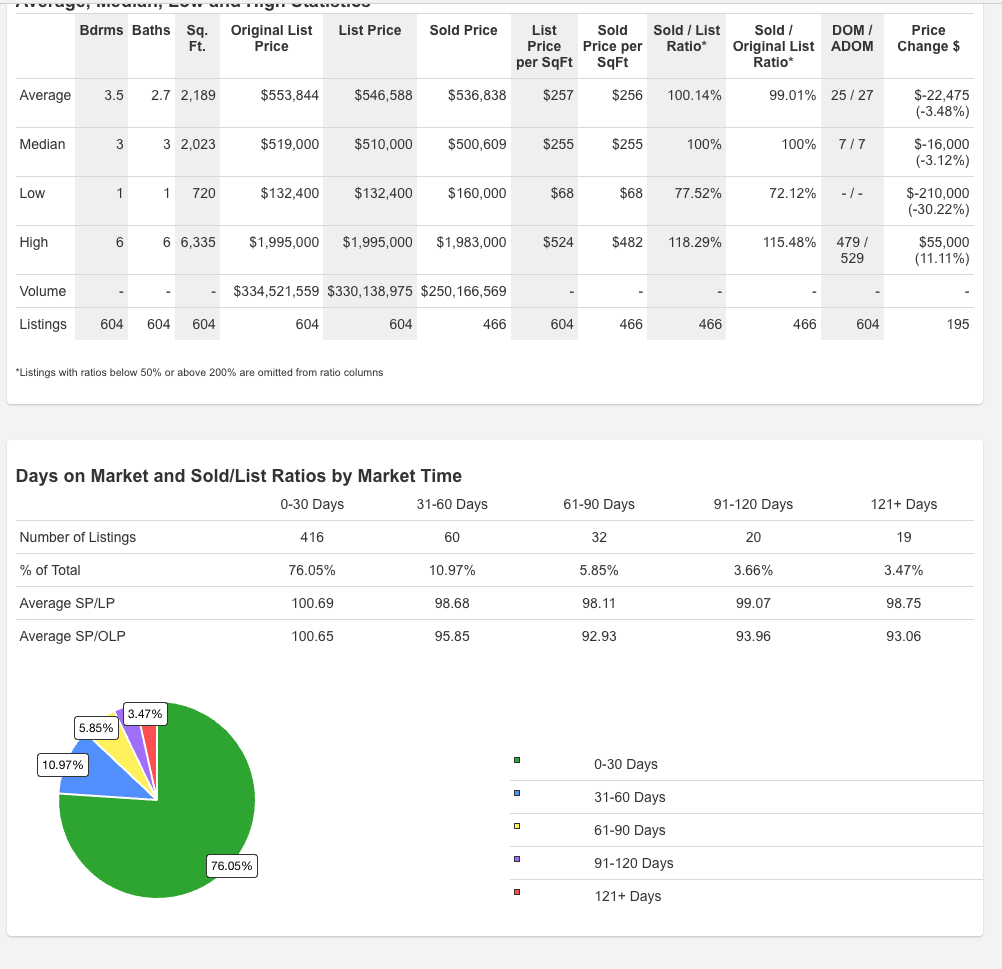
Trailing-12-month median sold $500,609 against a median list of $510,000 — 100% median SP/LP. With 547 closings behind it, the pattern is clear. Typical home is 3 beds / 3 baths at 2,023 SF.
547 closed sales cleared from 604 Eagle River listings on the trailing 12 months. The dominant pattern is fast absorption in the 0–30 day window.
Half of Eagle River homes sell in 7 days or less. Average DOM 25 / ADOM 27. The 0–30 day bucket accounts for 76.05% of closings.
Typical Eagle River home: 3 beds, 3 baths at 2,023 SF. Average (3.5 / 2.7 / 2,189 SF) reflects the range from 720 SF low to 6,335 SF high.
$250,166,569 across 547 trailing-12-month closings. OLP $334,521,559; list volume $330,138,975. The spread reflects Eagle River's typical price negotiation from a price-change-aware dataset.
Low sold $160,000 (1BR / 1BA / 720 SF), high sold $1,983,000 (6BR / 6BA / 6,335 SF). The range confirms Eagle River's broad inventory from entry-level condos to large acreage estates.
The trailing 12-month distribution (Jul 2025 – Jun 2026) across 547 closed sales from 604 Eagle River listings. With 547 closings behind it, the dataset is statistically the most comprehensive of any Anchorage-area neighborhood — read both the average and the median.
| Statistic | Beds / Baths / SF | OLP | List | Sold | $/sqft (L / S) | SP/LP / SP/OLP | DOM (CDOM) | Price Change |
|---|---|---|---|---|---|---|---|---|
| Average | 3.5 / 2.7 / 2,189 | $553,844 | $546,588 | $536,838 | $257 / $256 | 100.14% / 99.01% | 25 / 27 | −$22,475 (−3.48%) |
| Median | 3 / 3 / 2,023 | $519,000 | $510,000 | $500,609 | $255 / $255 | 100% / 100% | 7 / 7 | −$16,000 (−3.12%) |
| Low | 1 / 1 / 720 | $132,400 | $132,400 | $160,000 | $68 / $68 | 77.52% / 72.12% | — / — | −$210,000 (−30.22%) |
| High | 6 / 6 / 6,335 | $1,995,000 | $1,995,000 | $1,983,000 | $524 / $482 | 118.29% / 115.48% | 479 / 529 | +$55,000 (+11.11%) |
| Volume | 604 listed / 547 sold | $334,521,559 | $330,138,975 | $250,166,569 | — / — | — / — | — / — | — / — |
Across 547 trailing-12-month closings, 416 of 547 (76.05%) Eagle River homes cleared in 0–30 days at 100.69% sale-to-list / 100.65% sale-to-original-list — the dominant pattern. 60 listings took 31–60 days (10.97%), 32 took 61–90 (5.85%), 20 took 91–120 (3.66%), and 19 took 121+ days (3.47%). Saturation is concentrated in the 0–30 bucket; mid- and longer-tail buckets trend lower on sale-to-list.
| Days on Market | Share of Sales | Avg SP/LP | Avg SP/OLP |
|---|---|---|---|
| 0–30 days | 76.05% (416 listings) | 100.69% | 100.65% |
| 31–60 days | 10.97% (60 listings) | 98.68% | 95.85% |
| 61–90 days | 5.85% (32 listings) | 98.11% | 92.93% |
| 91–120 days | 3.66% (20 listings) | 99.07% | 93.96% |
| 121+ days | 3.47% (19 listings) | 98.75% | 93.06% |
Eagle River pricing varies significantly by location and lot size. Here's what buyers can expect in each sub-area:
| Sub-Area | Price Range | Lot Size | Property Type |
|---|---|---|---|
| Peters Creek | $350K – $550K | 0.5 – 1.5 acres | Older SFH, ranches |
| Eagle River Valley (entry) | $400K – $650K | 0.5 – 1 acre | Established SFH, townhomes |
| South Fork | $500K – $750K | 0.5 – 2 acres | 1980s–90s SFH, cul-de-sacs |
| Eagle Pointe | $550K – $800K | 0.75 – 2 acres | Newer construction SFH |
| Hiland Road | $700K – $1.2M+ | 1 – 5+ acres | Custom homes, acreage estates |
Eagle River's price-per-square-foot is meaningfully lower than comparable Anchorage urban neighborhoods, but the premium is in the land: buyers are paying for acreage, mountain views, and the lifestyle access that comes with proximity to the Chugach. For buyers comparing South Addition or Turnagain (both excellent urban neighborhoods) to Eagle River, the question is fundamentally about lifestyle priorities — walkability and urban access versus space, trails, and mountain valley living.
Eagle River is served by the Anchorage School District's Chugiak-Eagle River cluster — a group of six schools that serves the valley communities north of Anchorage. The cluster is known for strong community involvement, competitive athletics, and the kind of close-knit school culture that's harder to maintain in larger urban schools.
For families, the Chugiak-Eagle River cluster's relatively smaller class sizes compared to Anchorage proper are a consistent selling point. Teachers know students by name. School community events draw genuine participation. The outdoor education opportunities — field trips to the Nature Center, cross-country ski days, and science programs in Chugach State Park — are unmatched anywhere in the district.
Eagle River attracts a specific type of buyer — one who has made a conscious choice about how they want to live in Alaska:
The common thread: Eagle River residents chose Alaska because of what it offers — wilderness, space, the authentic frontier lifestyle. Eagle River delivers that promise without requiring a bush plane. It's Anchorage's answer to the question "where do you live if you love Alaska, have kids, and work in the city?"
Acreage properties and custom homes require a different approach than urban real estate. The Prince Group knows this market — every sub-area, every view corridor, and which listings are coming before they hit the MLS.
Median sold $500,609 over 547 trailing-12-month closings — full T12M data, sub-area pricing, and mountain valley guidance — in The Prince Group's Eagle River Market Report.
Read the Q2 2026 Report